 Qply
Qply
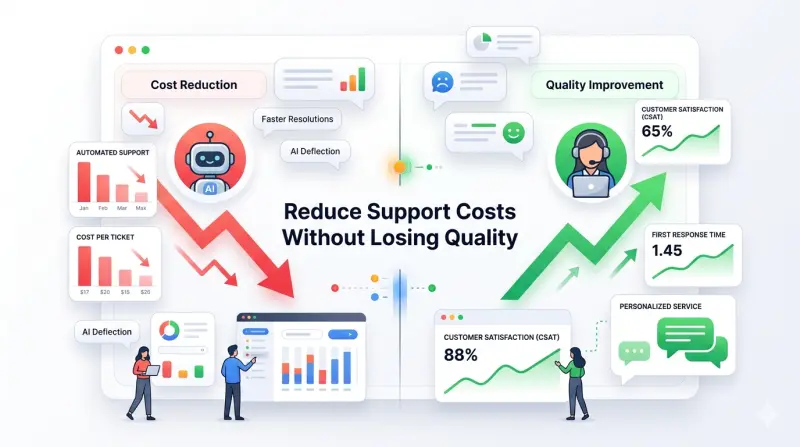
7 Proven Ways to Reduce Customer Support Costs Without Hurting Quality
Customer support is one of the biggest operational costs for growing businesses — and one of the most mismanaged. Most companies either overspend on agents who spend 80% of their time answering the same 10 questions, or they underspend and lose customers to slow, frustrating support experiences.
There's a better way. Here are 7 proven strategies to cut support overhead by up to 60% while improving the customer experience at the same time.
Annual cost of poor customer service globally — including lost customers, churn, and repeat support contacts (Accenture).
Deploy AI to handle repetitive questions automatically
Industry research consistently shows that 60–80% of support tickets are variations of the same questions: "Where's my order?", "How do I reset my password?", "What's your refund policy?". Every one of these answered by a human agent is money wasted on something a well-trained AI can handle in milliseconds.
Set up an AI chat widget with a knowledge base containing your most common FAQs, product documentation, and policies. Most businesses that do this see AI deflect 70–80% of incoming tickets within the first week.
💰 Cost reduction: 50–70% of ticket volumeBuild a self-service knowledge base
A well-structured help center or FAQ page is one of the highest-ROI investments in support. Every customer who finds the answer themselves is a ticket that never gets created. Tools like Qply let you upload your knowledge base directly — the AI reads it and answers questions accurately, even for edge cases.
The key is keeping it updated. Stale documentation breeds distrust and more support tickets, not fewer.
💰 Cost reduction: 20–40% of ticket volumeImplement smart ticket routing and triage
Not all support questions are equal. A billing dispute that could lead to churn needs human attention immediately. A feature request can wait for a weekly digest. Routing tickets by urgency, category, and customer tier prevents your best agents from being stuck on low-priority tasks while high-value customers wait.
Use tags, keywords, and customer data (plan type, spend level) to route automatically. Resolve simple questions with AI, escalate complex ones, and prioritize by revenue impact.
💰 Cost reduction: 15–25% of agent timeReduce tickets at the source with better UX
The best support ticket is one that was never created. Analyze your top 10 support questions and ask: Why are customers asking this? Usually it's because something in your product or website is confusing.
- Add contextual tooltips in your app for confusing features
- Improve your onboarding flow to prevent "how do I get started?" questions
- Add shipping/delivery estimate prominently on checkout pages
- Make your return/refund policy visible at every decision point
Use templates and macros for common responses
Even when human responses are needed, agents shouldn't be writing the same response from scratch every time. Create a library of templates for your 20 most common resolution types. A good agent with templates resolves tickets 3–4× faster than one writing everything fresh.
Review and update templates quarterly — outdated templates lead to incorrect responses, which create follow-up tickets and destroy the time savings.
💰 Cost reduction: 20–35% of agent handle timeShift to asynchronous support channels
Phone support is the most expensive channel — it requires agents to be available at a specific time, conversations can't be batched, and average handle time is 5–10 minutes. Email and chat are asynchronous and can be handled in parallel.
If you still offer phone support, consider limiting it to high-value customers (enterprise accounts, large orders) and routing everyone else to chat or email first. Most customers prefer a fast chat response over waiting on hold anyway.
💰 Cost reduction: 30–50% vs phone-first supportMeasure, then optimize — using the right metrics
You can't reduce costs you don't measure. The metrics that matter most:
- First response time (FRT): How fast does a customer get any response?
- First contact resolution (FCR): What % of issues are resolved in one interaction?
- Tickets per customer: Are specific cohorts generating disproportionate support load?
- AI deflection rate: What % of chats are fully resolved by AI without human involvement?
- Cost per ticket: Total support spend divided by ticket volume.
Set a monthly review to look at these numbers and identify the single biggest lever you can pull. Even improving FCR by 10% has a significant compound effect on costs over a year.
💰 Cost reduction: varies — identifies where to focusPutting it all together
The biggest mistake businesses make is treating these as isolated tactics. The highest-performing support operations stack all seven:
- AI deflects routine questions (reduces volume)
- Knowledge base enables self-service (reduces volume)
- Smart routing sends the right tickets to the right people (improves efficiency)
- Better UX reduces confusion-driven tickets (prevents volume)
- Templates speed up human responses (reduces handle time)
- Async channels replace expensive phone support (reduces cost per ticket)
- Metrics drive continuous improvement (compounds all savings)
Businesses that implement all seven typically see 40–significant reduction in support costs within 90 days — while simultaneously improving CSAT scores, because faster, more accurate support is simply better support.
Start reducing support costs today
Qply's AI auto-replies to common questions using your knowledge base. 14-day free trial · cancel anytime.
Start 14-day free trial →Related: AI Chatbot vs Live Chat: Which One Does Your Business Need? · How to Add Live Chat in 60 Seconds