 Qply
Qply
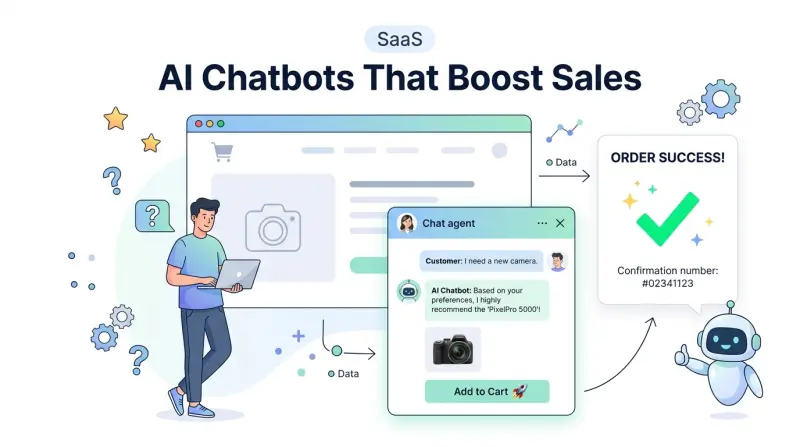
Best AI Chatbot for Ecommerce in 2026: Automate Support & Boost Sales
Running an ecommerce store in 2026 means fielding the same questions thousands of times a day: "Where's my order?", "Do you have this in size M?", "How do I return this?". Your support team is talented — they shouldn't be spending 70% of their day answering queries that a well-trained AI chatbot for ecommerce can handle instantly, around the clock, while your team focuses on the conversations that need a human.
This guide covers why ecommerce businesses specifically need AI-powered chat (not just generic live chat), the real ROI numbers you can expect, how to train your bot on your product catalog and FAQs, and the top 6 tools to consider in 2026. We'll start with Qply — our top recommendation — and walk through the full landscape.
Why Ecommerce Stores Need AI Chatbots (Not Just Live Chat)
Traditional live chat requires a human on the other end. That works when you have three orders a day. It completely breaks down during a product launch, Black Friday weekend, or when you expand into new time zones. Here's where AI chatbots fill the gap that human-only chat can never fully cover:
Cart Abandonment Recovery
The global average cart abandonment rate is just over 70%. A well-timed proactive chat message — triggered when a visitor has items in their cart and has been idle for 45 seconds — can recover a meaningful percentage of those sessions. AI chatbots can detect this behavior, send a targeted message, answer any last-minute objections (sizing, shipping cost, return policy), and get the customer across the finish line. Human agents can't monitor every session simultaneously; AI can.
Product Questions at Scale
Shoppers ask highly specific questions: compatibility, dimensions, material composition, stock at a specific variant level, bundle options. When you have hundreds or thousands of SKUs, it's impossible for any human team to recall every detail instantly. An AI trained on your product catalog answers these questions accurately in seconds, from your own data — no hallucinations, no "let me check and get back to you."
Order Tracking Without Agent Involvement
"Where is my order?" is, by most estimates, the single most common ecommerce support query. It can represent 30–40% of total inbound volume. An AI chatbot integrated with your order management system can pull live tracking data and respond instantly, deflecting an enormous chunk of your ticket queue without a single human touch.
Returns and Refunds Guidance
Returns are emotionally charged. Customers want answers fast. AI chatbots can walk customers through your return policy step by step, generate return labels (when integrated with your returns platform), and record the reason for return — all without escalating to a human unless the situation requires judgment. This alone typically reduces returns-related agent time by 40–60%.
24/7 Coverage Across All Time Zones
If you sell internationally, your customers are awake when your team is asleep. AI doesn't clock out. A customer in Singapore placing a midnight order who has a question about customs duties or delivery timelines gets an instant, accurate answer — not a "we'll respond within 24 hours" autoresponder that drives them to a competitor.
If your team handles 500 support tickets per week at an average of 5 minutes per ticket, that's ~42 hours of agent time weekly. A well-configured AI chatbot typically deflects 60–80% of those tickets. Even at 60% deflection, you're recovering 25+ hours per week — the equivalent of a part-time hire.
Top 6 AI Chatbots for Ecommerce in 2026
1. Qply — Best Overall AI Chatbot for Ecommerce (Our Top Pick)
Qply is purpose-built for businesses that want genuine AI automation without an enterprise contract. For ecommerce, its RAG (Retrieval-Augmented Generation) engine is the standout feature: you upload your product catalog, FAQs, return policy, and shipping documentation, and Qply's AI answers customer questions using only that content — no hallucinations, no confabulated specs.
Setup takes under 20 minutes. You embed a lightweight widget, connect your knowledge base, and the AI is live. There's no complex flow builder to maintain — the model learns from your documents rather than requiring you to pre-script every conversation path. For stores running Shopify, WooCommerce, or any custom storefront, the embed is a single script tag.
Flat-rate pricing means your monthly bill doesn't spike during high-traffic periods like sales events or holiday seasons. You're not charged per-resolution or per-conversation — which is particularly valuable for ecommerce where volume is spiky and unpredictable. Human escalation works seamlessly: when the AI detects frustration or a query beyond its knowledge, it hands off the conversation to a live agent with full context preserved.
2. Tidio — Best for Small Shopify Stores
Tidio is one of the most popular chatbot tools among Shopify merchants, and for good reason: it has a native Shopify app, a clean interface, and a solid free tier that's actually usable. Their "Lyro" AI assistant handles common queries reasonably well for stores with straightforward product lines. The visual flow builder makes it easy to create guided experiences for product recommendations.
3. Gorgias — Best for High-Volume Ecommerce Teams
Gorgias is built specifically for ecommerce support, with deep integrations into Shopify, Magento, and BigCommerce. It pulls order data, customer history, and product info directly into the agent view. Their AI automation can handle routine tickets end-to-end and is genuinely well-suited to high-volume stores doing thousands of orders per day. The trade-off is price — Gorgias bills per ticket, which makes costs hard to predict and expensive during peak periods.
4. Freshchat — Best for Omnichannel Ecommerce
Freshchat (now Freshdesk Messaging) covers web chat, WhatsApp, Instagram DMs, and email in a unified inbox — which makes it a strong choice for ecommerce brands with an active social commerce presence. Their "Freddy" AI handles intent-based routing and can deflect a reasonable volume of standard queries. Full AI features require higher-tier Freshworks plans, so budget accordingly.
5. Intercom — Best for Enterprise Ecommerce
Intercom's "Fin" AI agent is one of the more capable enterprise-grade chatbots available. For large ecommerce operations with dedicated support teams and large budgets, the product depth is hard to match. That said, pricing is per-resolution for the AI agent tier, which means a busy promotional period can result in a very large bill. Smaller and mid-sized stores typically find better value elsewhere.
6. Tawk.to — Best Free Option for Early-Stage Stores
Tawk.to is 100% free and a legitimate starting point for early-stage ecommerce stores that primarily need a human chat channel. There's no AI, no automation — just a clean widget that lets you chat with site visitors manually. It's the right tool if you're doing fewer than 20 support conversations a day and have the bandwidth to respond personally. Once volume grows, you'll want to upgrade to an AI-powered solution.
Real ROI: What to Expect from an Ecommerce AI Chatbot
The numbers vary by store type, product complexity, and how well you train the AI — but here are realistic benchmarks based on stores that have deployed AI chat effectively:
- Ticket deflection rate: 60–80% of inbound support volume handled without human involvement
- First response time: Drops from hours (for email) or minutes (for live chat) to under 3 seconds — 24/7
- Cart recovery lift: 5–15% improvement in cart-to-purchase conversion when proactive AI chat is triggered on high-intent abandonment sessions
- CSAT scores: Typically maintained or improved — customers value instant answers over waiting for a human response to a simple question
- Support cost per ticket: Drops by 40–70% when AI handles the majority of volume
According to Salesforce's State of Service report, 83% of customers expect to interact with someone immediately when contacting a company. AI chatbots are currently the only way to guarantee that expectation is met at scale. Human agents remain essential — but for queries that follow a pattern, AI is faster, more consistent, and available around the clock.
How to Train Your AI Chatbot on Your Product Catalog and FAQs
The quality of your AI's responses is entirely determined by the quality of the content you train it on. A poorly documented knowledge base produces vague, unhelpful answers. A well-structured one produces responses that customers can't distinguish from a knowledgeable human agent. Here's the process that works best for ecommerce stores:
Step 1: Export and Structure Your Product Data
Start with your product catalog. Export a clean CSV or structured document that includes: product names, full descriptions, dimensions, materials, compatibility notes, variant-level details (size, color, stock), and any known FAQs specific to each product. The more specific the data, the more precise the AI's answers.
Step 2: Document Your Policies Clearly
Write your return policy, shipping policy, warranty terms, and payment options as clean, plain-language documents — not legal boilerplate. AI trained on dense policy language produces dense policy answers. Train it on human-readable summaries and it produces human-readable responses.
Step 3: Build a FAQ Document from Real Support History
Pull your last 90 days of support tickets. Find the 30 most frequently asked questions. Write clear, complete answers to each. This single document will drive the majority of AI deflections because it maps directly to what customers actually ask.
Step 4: Test Before Going Live
Before deploying, spend 30 minutes asking your AI chatbot every question you can think of — including tricky edge cases. Identify gaps, update your knowledge base, and re-test. A good AI chatbot tool (like Qply) will tell you when it doesn't have enough information to answer confidently and escalate gracefully rather than guessing.
Step 5: Iterate Based on Missed Questions
Review unanswered or escalated conversations weekly for the first month. Every escalation is a signal that your knowledge base has a gap. Fill it, and your deflection rate will climb week over week.
For a broader guide on reducing your overall support burden, see our article on how to reduce support tickets with AI — which applies directly to ecommerce workflows.
Choosing the Right AI Chatbot for Your Ecommerce Store
The right tool depends on where you are in your business journey:
- Early-stage store (<100 orders/month): Start with Tawk.to for free human chat, or Qply if you want AI from day one without a large budget commitment
- Growing store (100–1,000 orders/month): Qply or Tidio — both offer strong AI at accessible price points
- Scaling store (1,000–10,000 orders/month): Qply (flat-rate, predictable) or Gorgias (if you need deep platform integration)
- Enterprise store (10,000+ orders/month): Gorgias or Intercom, though the per-resolution pricing of Intercom's AI tier warrants careful modeling
- Omnichannel brand (web + social commerce): Freshchat for its multi-channel coverage
If you're running Shopify specifically, also see our guide on the best live chat tools for Shopify for a platform-specific breakdown.
Ecommerce stores are acutely sensitive to page load times — every 100ms of delay can reduce conversion rates by 1%. Make sure the AI chatbot widget you choose is lightweight. Qply's widget is under 30KB. Some enterprise tools ship 200KB+ scripts. Check the bundle size before you commit.
The Bottom Line
An AI chatbot for ecommerce is no longer a luxury — it's the most cost-effective way to provide the instant, accurate, 24/7 support that modern shoppers expect. The stores winning on customer experience in 2026 are the ones that handle routine queries automatically and free their human agents to focus on genuinely complex situations that require empathy and judgment.
Qply gives you RAG-powered AI trained on your own data, flat-rate pricing that doesn't spike during your best sales days, and a widget light enough to deploy without hurting your Core Web Vitals. Setup takes minutes, not days — and the deflection rate improvement typically pays for itself within the first month.
Add AI chat to your ecommerce store today
Train it on your catalog and FAQs. Go live in under 20 minutes. No per-resolution fees.
Start 14-day free trial →